
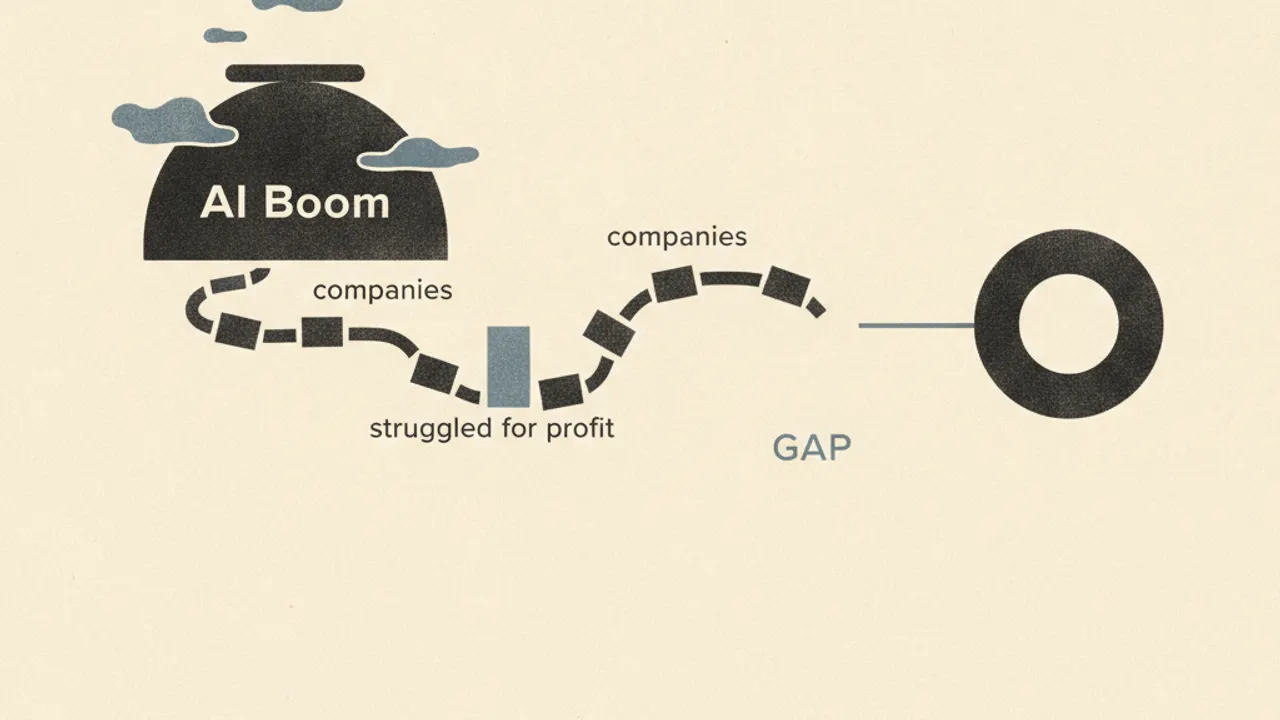
Artificial intelligence usage in corporate environments has reached record levels, yet financial returns are lagging behind management expectations. While employees worldwide report personal efficiency gains, the technology has not translated into bottom-line gains for most organizations. Recent research highlights that while companies invest heavily in software licenses, measurable operational improvements remain elusive.
A representative survey by Gallup underlines this clear disconnect in daily business practice. Approximately 65 percent of workers at AI-using companies state that tools have boosted their personal efficiency. However, only 12 percent strongly agree that AI has fundamentally transformed the way their organization works. Adoption remains mostly confined to task-level execution, such as drafting emails or summarizing documents.
McKinsey's recent research confirms this gap between technological excitement and financial reality. While 64 percent of surveyed organizations report positive impulses for their innovation capacity, only 39 percent observe a measurable positive effect on EBIT. A primary reason is scaling failure, with only 38 percent of companies successfully moving AI solutions beyond the pilot and testing phase.
This imbalance is further exacerbated by uneven usage patterns across workforce demographics. According to Gallup, about 30 percent of US workers use AI tools frequently in their daily work, while 20 percent use them rarely. Nearly half of the workforce does not use AI at all or uses it at most once a year. Without systematic training and role redefinitions, broad productivity growth remains unachieved.
High-performing organizations adopt radically different strategies to maximize economic value. According to McKinsey, top performers are 3.6 times more likely to fundamentally redesign entire business workflows. Furthermore, these leaders reinvest up to five times more of their digital budgets into AI expansion. This demonstrates that true financial returns demand deep organizational restructuring.